
New York/Venezuela
Diaspora chapter for Venezuelan memory, philanthropy, archive and contemporary art. It is articulated with VAEA as the 501(c)(3) institutional partner for this chapter.
Applied study · Framework page
Framework page · version 1.1 · last editorial update: June 2026.
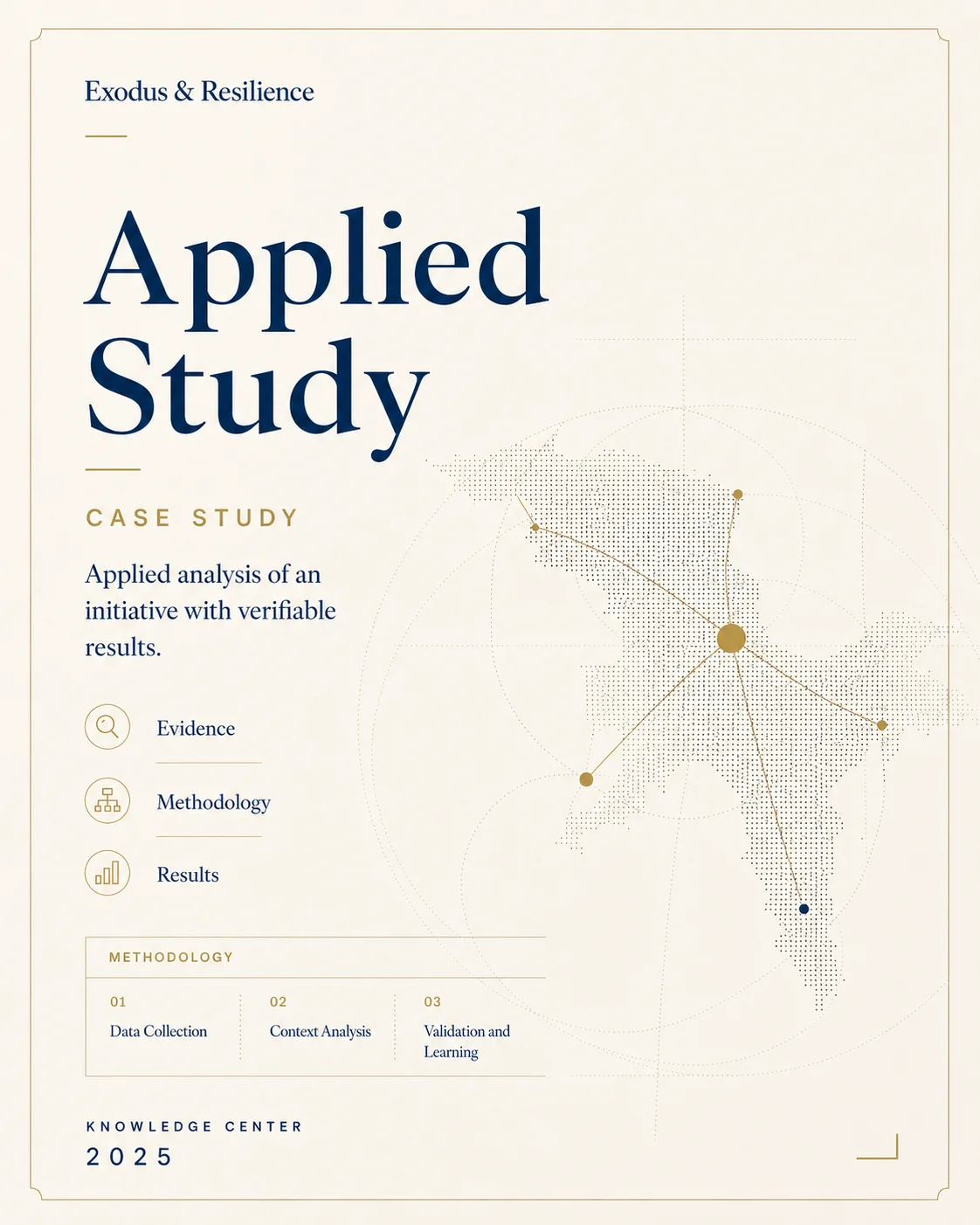
This page presents the institutional structure of the Applied Study document of Exodus & Resilience. Its definitive content will be published when the first operating cycle generates verifiable evidence, according to the phased governance model.
Until then, this page remains accessible for institutional transparency purposes and does not represent an approved, signed or definitive document for external public use.
If you need a definitive, signed and dated version for institutional due diligence, you may request it at contact@exodusandresilience.org.
Document download: the definitive PDF version will be published when the document is dated, reviewed and approved. Any current downloadable version should be treated as a framework draft unless expressly identified otherwise.
Download PDFThis applied study establishes an initial guide for analyzing how cultural practices may contribute to community cohesion, belonging, well-being and the construction of public memory in contexts shaped by migration, unequal cultural access and social fragmentation.
Exodus & Resilience is currently in its founding phase. For that reason, this document does not present program results as definitive. It defines questions, methodology, observation criteria and learning lines that will be applied when each founding chapter enters implementation and generates verifiable evidence.
Methodological note: empirical findings, indicators and conclusions will be published only when data has been collected, validated and documented by chapter. Until then, this document functions as an applied research framework.
Under what conditions, through which cultural devices and by what documented processes can art, mediation and memory work contribute to community cohesion, belonging, well-being and the production of shared memory in communities linked to migration?
The question does not begin from a promise of automatic impact. It begins from an institutional hypothesis: culture can function as social infrastructure when there is continuity, mediation, documentation, local partnership and proportionate evaluation.
The framework will be progressively applied to the three founding chapters of Exodus & Resilience: New York/Venezuela, Caracas and Acarigua. Together they articulate diaspora, origin and interior territory as complementary fields of cultural research.
Diaspora chapter for Venezuelan memory, philanthropy, archive and contemporary art. It is articulated with VAEA as the 501(c)(3) institutional partner for this chapter.
Origin chapter focused on symbolic return, urban memory, emotional reconnection and public activation. Its implementation depends on funding, partnerships and verifiable operational conditions.
Interior-territory chapter focused on permanence, regional museum infrastructure, education and living archive, developed with Fundación Museo de Arte Acarigua-Araure as formal local institutional ally.
The study articulates three fields of analysis: culture and migration, public memory and community well-being, and cultural infrastructure as long-term installed capacity.
It avoids an assistentialist reading of communities. The approach prioritizes cultural rights, capabilities, participation, local agency and institutional traceability.
The methodology will be applied as chapters enter implementation. Each case study must identify source, date, sample, limitations and verification method.
Every process must respect informed consent, data protection, responsible use of imagery and the safeguarding policy.
See safeguarding policy (framework page)Each case study should analyze whether the program produces access, continuity, learning, public archive, local partnerships, cultural opportunities and institutional traceability.
These indicators will be published as results only when data has been collected, reviewed and contextualized. In this phase, they function as an observation framework.
See impact methodologyAt this stage, Exodus & Resilience identifies three learning hypotheses that will need to be verified with chapter-specific evidence.
The continuity of cultural activities may produce stronger outcomes in cohesion, belonging and trust than isolated interventions.
Sustained cultural mediation with territorial ties may be decisive in activating participation, learning and community appropriation.
Spaces for memory and documentation may contribute to shared narratives that mitigate fragmentation and support recognition.
These hypotheses are not presented as results. They will be evaluated through specific case studies, with sources, limits and documented methodology.
These recommendations are design criteria for future operating cycles. They do not constitute empirical conclusions or evaluation results.
This document does not report final results, verified participation figures or causal conclusions. Its function is to establish the analytical framework that will allow future cases to be evaluated with methodological prudence.
Conclusions will be published only when each chapter has developed documented activities, collected and verified data, and has the necessary context to interpret outcomes responsibly.
Evaluation is understood as an institutional learning process, not as a promotional communication tool.
This document will be updated as academic partnerships are formalized, chapter activities are executed and case studies with verifiable evidence are published.
This document is part of the public knowledge system of Exodus & Resilience and guides the future production of case studies across the founding chapters.