New York
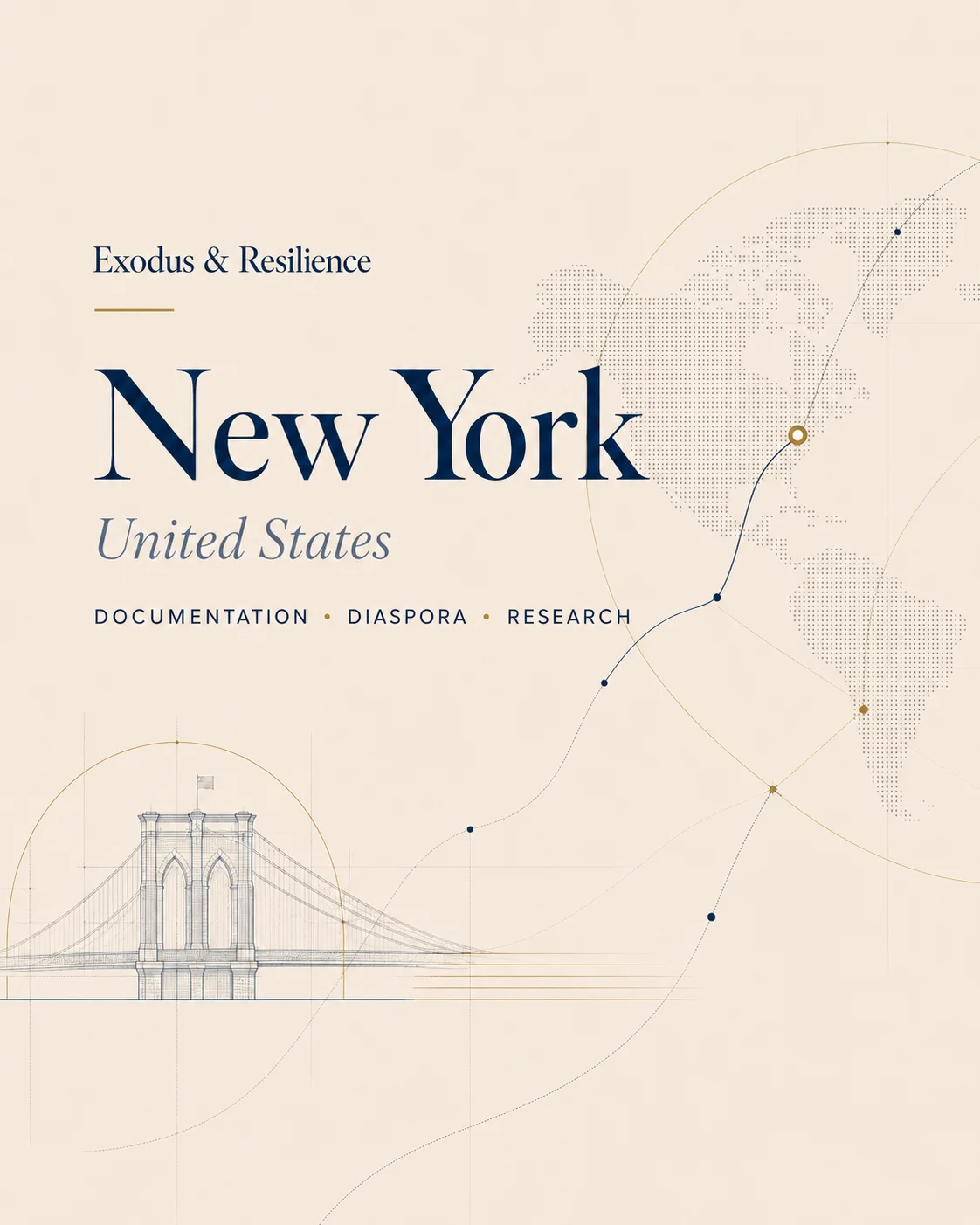
International node for Venezuelan diaspora, archive and contemporary art. Executed through a formalized institutional alliance with the Venezuelan American Endowment for the Arts (VAEA), a 501(c)(3) organization.
Territorial programs
Exodus & Resilience organizes art, memory and migration through territorial programs anchored in specific contexts. Its four current nodes belong to the founding phase of the platform and share a common framework of methodology, governance, documentation, traceability and public knowledge production.
Nodes
The nodes are not presented as consolidated operations. New York and Acarigua have formalized institutional alliances; Barcelona and Caracas are in the design phase and open institutional conversations.
This is the institutional headquarters of Exodus & Resilience. For local programming, team information, open calls and territorial indicators for each node, consult the corresponding subdomain when published.
Exodus & Resilience operates through territorial programs: curatorial, educational and community devices anchored in a specific geographic, cultural and institutional context. Each program responds to the particular conditions of its territory and shares with the others the same methodological framework, governance architecture and conceptual grammar: leave, sustain, recompose.
The four current programs correspond to the founding phase of the platform. They are organized around the experience of the Venezuelan diaspora —the field where Exodus & Resilience has developed its methodology and built its first institutional alliances— and around the territories that this diaspora connects: the city of origin, the intermediate city, the city of reception in Southern Europe and one of the most connected international city networks in the world.
This four-node model is replicable by design. The six-stage methodology, institutional partnership protocols, impact measurement frameworks and governance architecture are built to be applied to other migration contexts, other communities and other territories. New programs may join the Exodus & Resilience ecosystem as the platform expands its institutional capacity and partnerships.
International node for Venezuelan diaspora, archive and contemporary art. Executed through a formalized institutional alliance with the Venezuelan American Endowment for the Arts (VAEA), a 501(c)(3) organization.
Node for cultural mediation, active reception, intercultural education and recomposition of belonging in a city of multiple migrations. Program in design, open to dialogue with accredited local cultural institutions.
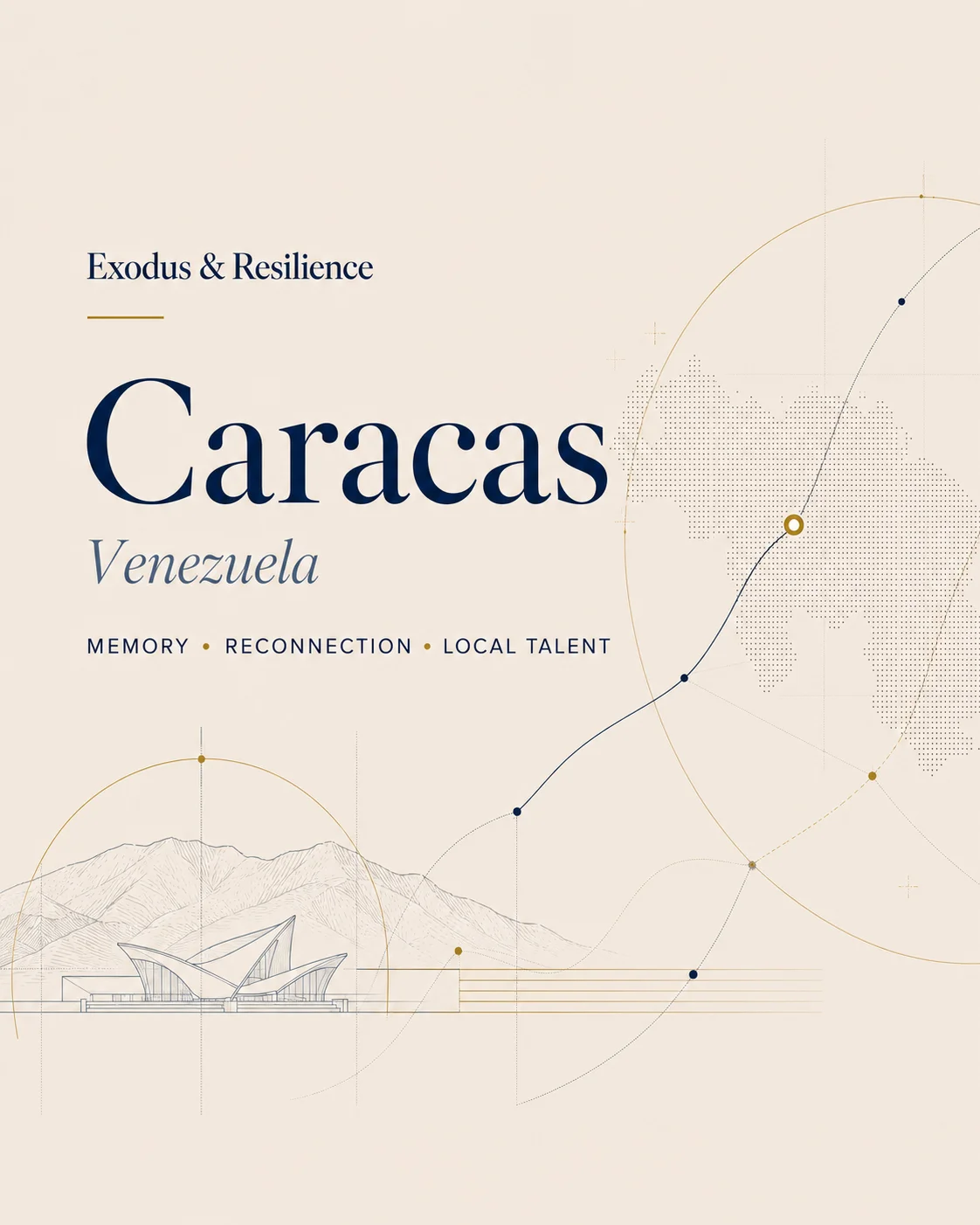
Node for memory, symbolic return, documentation of the Venezuelan diaspora and intergenerational cultural dialogue. Program in design, in articulation with local cultural and community partners.
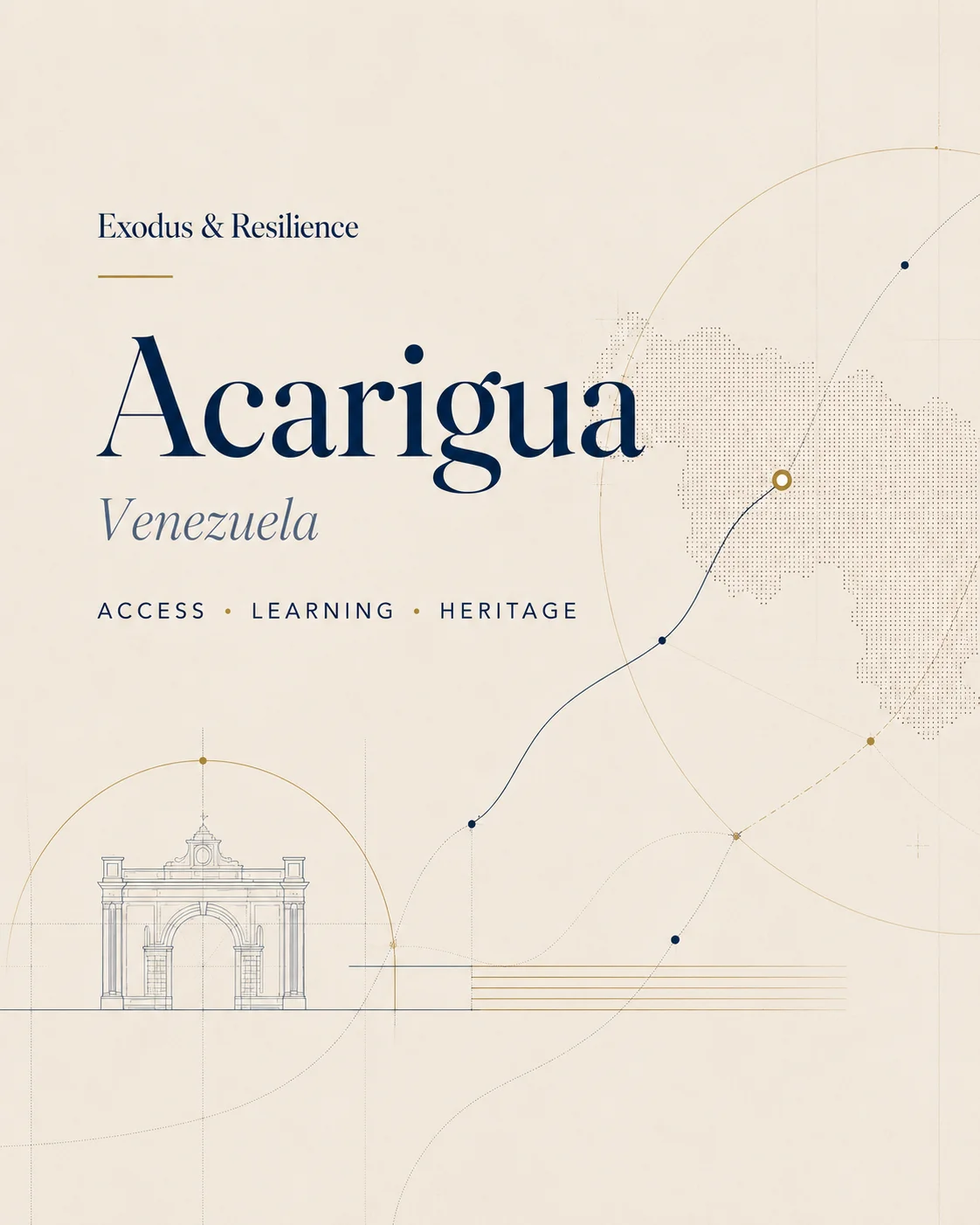
Node for living archive, intermediate city, cultural decentralization, training and the memory of those who remain. Executed through a formalized institutional alliance with the Fundación Museo de Arte Acarigua-Araure.
The operational activation of each node will be published when the corresponding program enters implementation with the institutional, operational and financial conditions required to document it responsibly. Program indicators —participants, workshops, training hours, beneficiaries, documented works, active partnerships and educational outcomes— will be published only when verified data are available, with their verification methodology.
Shared conceptual grammar
The four programs share a common conceptual grammar: leave, sustain and recompose. This structure allows each node to preserve its territorial specificity while maintaining institutional, curatorial and methodological coherence.
Leaving does not only mean moving. It involves the rupture of cultural ecosystems, professional circuits, symbolic roots and previous institutional fields. New York works with this dimension through diaspora; Caracas through symbolic return; Barcelona through arrival; Acarigua through the territory that sees people leave.
To sustain is to maintain bonds, memory, networks, cultural practices and forms of care across distance. From the perspective of transnationalism (Glick Schiller, Basch and Szanton Blanc, 1994), migrant communities do not abandon origin: they sustain it materially, affectively and culturally from multiple territories.
To recompose is to produce new forms of belonging, cultural citizenship and public recognition. From the third space (Bhabha, 1994), art in migration contexts belongs neither only to origin nor only to destination: it produces its own grammar.
Exodus & Resilience understands curating as civic infrastructure. From the perspective of expanded curating (O'Neill, 2007; Obrist, 2008), the work is not limited to selecting artworks for an exhibition: it includes research, archive, mediation, education, documentation, editorial production, institutional partnerships and impact measurement.
This perspective allows the four nodes to operate as complete curatorial devices. New York produces archive and institutional legitimacy for artists in diaspora. Barcelona works with cultural mediation and contact zones in a city of multiple migrations. Caracas addresses memory, postmemory and symbolic return. Acarigua builds a living archive from an intermediate city and from the experience of those who remain.
Operational use: this conceptual layer does not replace existing content. It reinforces it. It guides criteria for artist selection, selection of existing works, commissions of new work, exhibition texts, public mediation, installation, archive and impact evaluation.
Operating framework
Programs do not replicate activities mechanically. They share an institutional methodology that each city adapts according to its social, cultural, community and fiscal context.
Territorial reading of needs, actors, resources, cultural gaps, migrant imaginaries and opportunities.
Curatorial, educational and community framework adapted to each node.
Programs, mediation, training, archive and public encounters once the node enters implementation.
Records of processes, partnerships, artworks, testimonies, verifiable outcomes and learnings.
Indicators, sources, methodology, institutional traceability and qualitative impact reading.
Public reporting of evidence, limitations, learning and institutional accountability.
Territorial profiles
Each city contributes a specific dimension to the ecosystem. The institutional platform connects those differences under one logic of cultural, social and educational infrastructure.
International node for Venezuelan diaspora, archive and contemporary art. Its central question is how to transform dispersion into public memory, professional documentation, cultural citizenship and institutional circulation.
Explore the programNode for cultural mediation, active reception and intercultural education in a city of multiple migrations. Barcelona operates as a contact zone (Pratt, 1992): a space where migrant and receiving cultures meet, negotiate and produce new forms without erasing their differences.
Explore the programNode for memory, postmemory and symbolic return. Caracas functions as a site of memory (Nora, 1984): a cultural support where the diaspora critically processes its relationship with the territory of origin.
Explore the programNode for living archive, intermediate city and the memory of those who remain. Acarigua allows migration to be observed from the territory that sees people leave and from the intangible heritage that remains at risk of interruption.
Explore the programThe Fundación Museo de Arte Acarigua-Araure is mentioned in text only. Its logo must not be used in public materials until formal brand-use authorization has been granted.
Defining the conceptual logic of each node with precision allows for better curatorial decisions. The question is not only to identify Venezuelan or migrant artists, but to recognize practices capable of activating memory, archive, mediation, education, cultural citizenship and public reflection.
The work or practice must engage with migration, memory, diaspora, archive, territory, belonging, displacement, hospitality, cultural rights or identity recomposition.
Evaluation includes formal maturity, consistency of language, production quality, verifiable trajectory and ability to sustain critical reading in institutional contexts.
The work must be able to enter a living archive through technical records, interviews, process narrative, audiovisual documentation, critical text or pedagogical sheet.
The work must be able to activate mediation, public conversation, critical thinking and learning materials for communities, students, teachers, researchers and institutions.
These criteria do not replace the specific curatorial evaluation of each node. They function as a shared framework to avoid dispersed selections and ensure coherence between exhibition, archive, education, impact and governance.
The institutional website concentrates the general framework: mission, model, governance, aggregated indicators, partnerships, reports, transparency, fiscal architecture and the cross-cutting conceptual grammar.
Territorial subdomains concentrate local life: agenda, workshops, team, stories, images, city partners, open calls, activity documentation, archive, educational programming and specific metrics once each node enters implementation.
It defines the shared framework, articulates partnerships, explains governance, publishes aggregate reports and connects the four nodes.
See governanceThey present local programming, open calls, city-level documentation, images, calendar, specific partners and territorial outcomes when the corresponding node is active.
Back to nodesA node should not open only for visibility. It should exist where there is documented need, anchored community, institutional partners and the capacity to sustain the program over time.
The operational activation of each node will be published when the corresponding program enters implementation with the institutional, operational and financial conditions required to document it responsibly.
Program indicators —participants, workshops, training hours, beneficiaries, documented works, active partnerships and educational outcomes— will be published only when verified data are available, with their verification methodology.
The Exodus & Resilience model is replicable in cities where there is documented need, anchored community, institutional partners, curatorial relevance and sustained philanthropic commitment.
If your organization is interested in exploring a new territorial node, we can open a strategic conversation to assess relevance, resources, governance, sustainability and coherence with the platform's shared grammar.
Propose a new nodeOur objective is for each node to preserve its local identity while contributing to a shared architecture of cultural, social, educational and documentary impact.